






The DiPPa™ Framework: Turning Digital Product Passport Data into Competitive Advantage
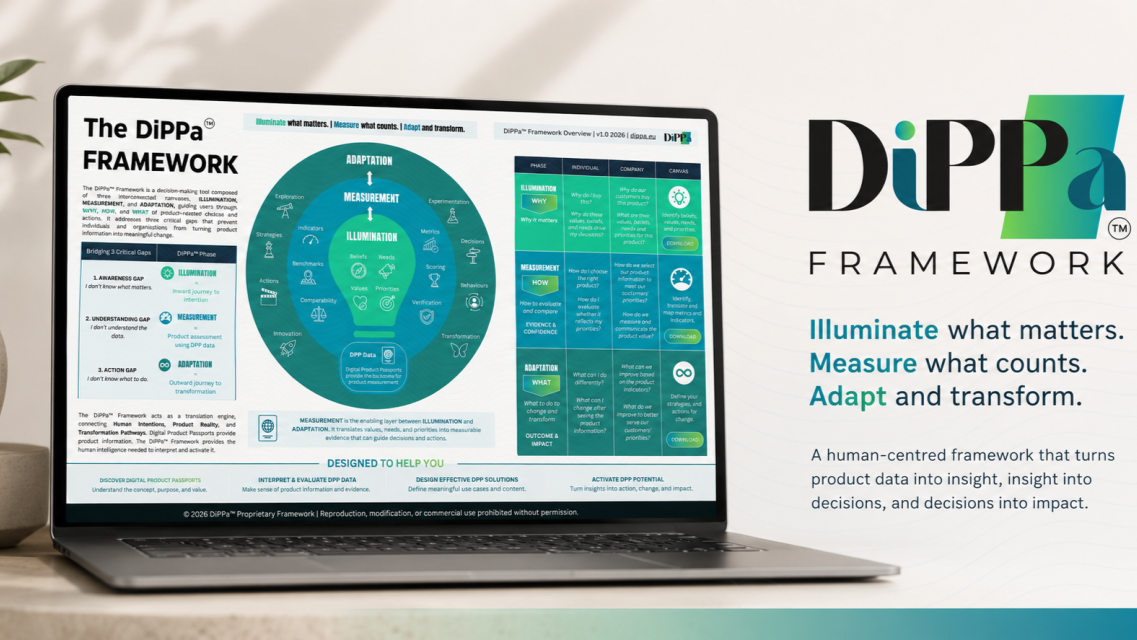
Illuminate what matters. Measure what counts. Adapt and transform.
Digital Product Passports are arriving, and the regulations and data infrastructures needed to support them are beginning to take shape. But the question that matters most is not what a DPP is legally required to contain: it is what decisions that data should drive, what a product should become, and how customers come to recognise its value rather than default to price.
The DiPPa™ Framework is a decision-making framework built for the Digital Product Passport (DPP) era, applicable across industries and requiring no prior technical or regulatory expertise. It reframes the DPP from a reporting obligation into a strategic opportunity: the organisations that lead in a world of mandatory product transparency will not be those that minimise their disclosures, but those that understand what their customers prioritise, present their data in interpretable and comparable formats, and position their products as credibly best in class. These are product strategy questions, not compliance questions, and answering them well is a matter of human intelligence rather than automation.
The DiPPa™ Framework provides the method for making that judgement, structured around three phases, Illumination, Measurement, and Adaptation, following a WHY-HOW-WHAT sequence that converts human intentions into product evidence, and product evidence into meaningful action. Each phase has a corresponding downloadable canvas at https://www.dippa.eu/, free to use in workshops, strategy sessions, and individual reflection alike.
01. Illumination (WHY)
Why do customers buy this product, and what values, beliefs, and priorities do they hold for it?
Illumination is the first phase, and the one that gives every decision that follows its direction. Illumination identifies what matters, whether starting cold or working backward from an existing Digital Product Passport, because data only becomes useful once connected to something meaningful. Its conceptual foundation is the Triple Bottom Line: People, Planet, and Profit, the three dimensions that underlie every product decision and the trade-offs across them.
Most organisations already have strong intuitions about what matters to their customers; what they lack is a structured way to make those intuitions explicit. The Illumination Canvas does exactly that, producing a priority map across People, Planet, and Profit: the product WHY that Measurement and Adaptation build on.
02. Measurement (HOW)
How do you evaluate whether the product reflects those priorities?
Measurement is the bridge between the intentions identified during Illumination and the actions developed during Adaptation, translating priorities into evidence that Adaptation can act on. Its conceptual foundation is a product data classification inspired by the EU Battery Regulation, extended into an industry-agnostic structure across data categories: Basic Product Information and Compliance, Performance Metrics, Material Transparency, Supply Chain Accountability, Climate Reality, and Circular Metrics.
Current mandatory DPP requirements focus mainly on environmental and performance dimensions; the DiPPa structure includes social data deliberately, reflecting the fuller picture responsible production and consumption require. Selecting the categories is only half the task: making the data comparable, through standardised scoring, benchmarks, and accessible visualisation, is what turns it into a genuine activation tool rather than a technical repository, much as the energy label once did for consumption data.
03. Adaptation (WHAT)
What can you do differently?
Adaptation is where the priorities from Illumination and the evidence from Measurement translate into different decisions, redesigned processes, new business models and strategic directions.
Its conceptual foundation is the Infinite Loop: two interlinked wheels, production and consumption, forming a continuous regenerative cycle in which waste is treated as a design failure rather than an inevitability. The DPP makes this operationally possible by carrying trusted product data from design through end-of-life and back again, connecting all value chain stakeholders from manufacturers, distributors, consumers, repair services, collectors, to recyclers, and more around shared information about the same product.
The Production Wheel spans design, where choices determine what is possible later; manufacturing, where supply chain accountability is built in or absent; and distribution, where standardised digital information reduces redundant documentation across markets. The Gate is the point of purchase, where all data generated across the Production Wheel becomes accessible in a single scan. The Consumption Wheel spans purchase, use and maintenance, repair and upgrade, reuse and refurbishment, and end-of-life recovery, each stage feeding data back into the next generation of design.
The Adaptation Canvas guides organisations through lifecycle mapping, identifying where decisions have the most impact and where DPP data can most directly change what they do: turning WHY and HOW into WHAT to do.
From Better Decisions to Better Products
Investing in a Digital Product Passport without working through Illumination and Adaptation risks delivering very little beyond compliance. Building compliant, structured product data answers the HOW. On its own, without understanding what customers actually prioritise or defining what the next generation of products should become, that data lacks direction, and much of its long-term value remains untapped.
The DiPPa™ Framework provides the missing decision-making layer:
- Illumination can support the development of impactful customer surveys, user research, and UX insights to identify what truly matters to customers and which product priorities deserve attention.
- Measurement translates those priorities into structured, comparable product evidence and identifies the information the DPP should highlight and help evaluate.
- Adaptation uses those priorities and evidence to inform strategic product roadmaps, customer experience, and product positioning and marketing.
The framework can be applied before, during, or after a DPP project, depending on the organisation’s starting point. It can also be revisited as customer expectations, technologies, regulations, and product performance evolve, helping teams reassess priorities and refine their roadmaps over time.
A DPP treated only as a compliance exercise, built reactively to satisfy minimum legal requirements, captures little of this opportunity. Built deliberately and activated through the framework, it becomes a credible product story that can be communicated to customers, evidence that supports differentiation and long-term value creation, and an evolving source of insight into what the next generation of products should become.
This is not only about sustainability or circularity. The same customer priorities and product evidence that support responsible sourcing also inform innovation, user experience, product quality, trust, and long-term competitiveness because a better product is, at its core, one that people genuinely want to use, trust, and keep.
Digital Product Passports provide the product information. The DiPPa™ Framework brings the human intelligence needed to understand what customers value, decide which evidence matters, and determine what actions should follow. Together, they transform product data into better decisions, and better decisions into better products.
Download the DiPPa™ Framework: https://www.dippa.eu/framework
The three DiPPa™ Framework canvases are available to download free at dippa.eu. They are designed for workshops, strategy sessions, executive education, and product teams looking to turn Digital Product Passport information into better product decisions.
Explore the Book: https://www.dippa.eu/book
To explore the methodology in greater depth, read DiPPa: Rethinking the Way We Buy Things with Digital Product Passports, authored by Marion Rouzeaud. Drawing on conversations with experts across industry, academia, and policy, the book explores how Digital Product Passports can move beyond compliance to become strategic tools for better decisions, better products, and more transparent value chains.