


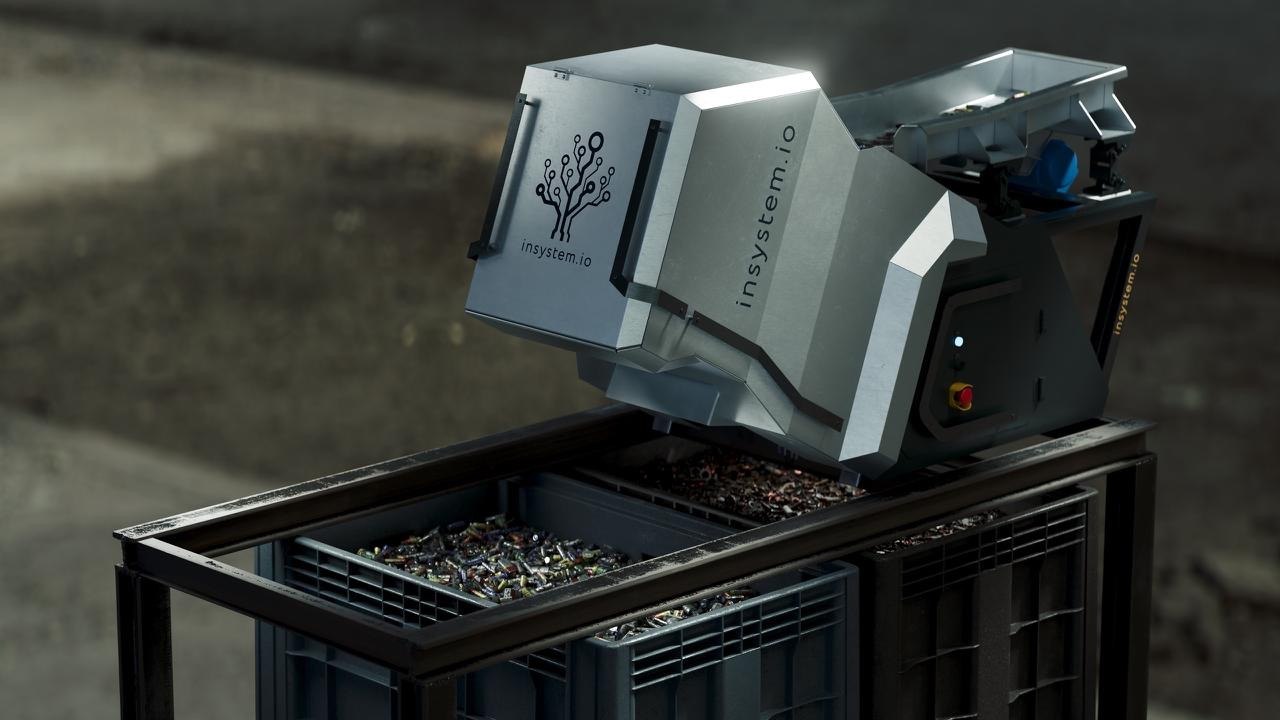
Dutch start-up has introduced a next-generation solution — the Gravity Sorter, a belt-free optical sorting system designed to handle complex waste streams.
Battery recycling rates remain low amid growing demand. Industry estimates suggest that only around 15% of batteries are currently recycled, while up to 85% remain outside formal recycling streams, resulting in the loss of valuable materials such as lithium, cobalt, nickel, and copper.
One of the key technical limitations lies in conventional belt-based optical sorting systems, where overlapping objects and restricted visibility reduce detection accuracy.
Against this backdrop, Dutch start-up inSystem.io has introduced a next-generation solution — the Gravity Sorter, a belt-free optical sorting system designed to handle complex waste streams.
The system uses an AI-powered camera to track free-falling objects, capturing multiple images per item and calculating trajectories in real time with an accuracy of up to 2 mm. Reported sorting purity exceeds 96%.
According to the developer, the system processes materials ranging from 5 to 65 mm, with a throughput capacity of up to 6 tonnes per hour, featuring multi-angle identification and full object visibility without overlap.
The technology is aimed at applications such as battery recovery from ferrous scrap, WEEE processing, and the recovery of non-ferrous metals from incineration bottom ash.