


Textile Recycling at Scale: Data, Infrastructure or Demand?
What will unlock Europe’s transition from textile waste to a circular system? Two industry experts share their perspectives on Digital Product Passports, industrial infrastructure and the market conditions needed to scale textile-to-textile recycling.
Europe is investing heavily in textile circularity, while Digital Product Passports (DPPs) are increasingly seen as a key enabler for better traceability and recycling efficiency.
But is the lack of product-level data really the biggest challenge facing the industry?
For this edition of Circular Economy News Expert Insights, we spoke with:
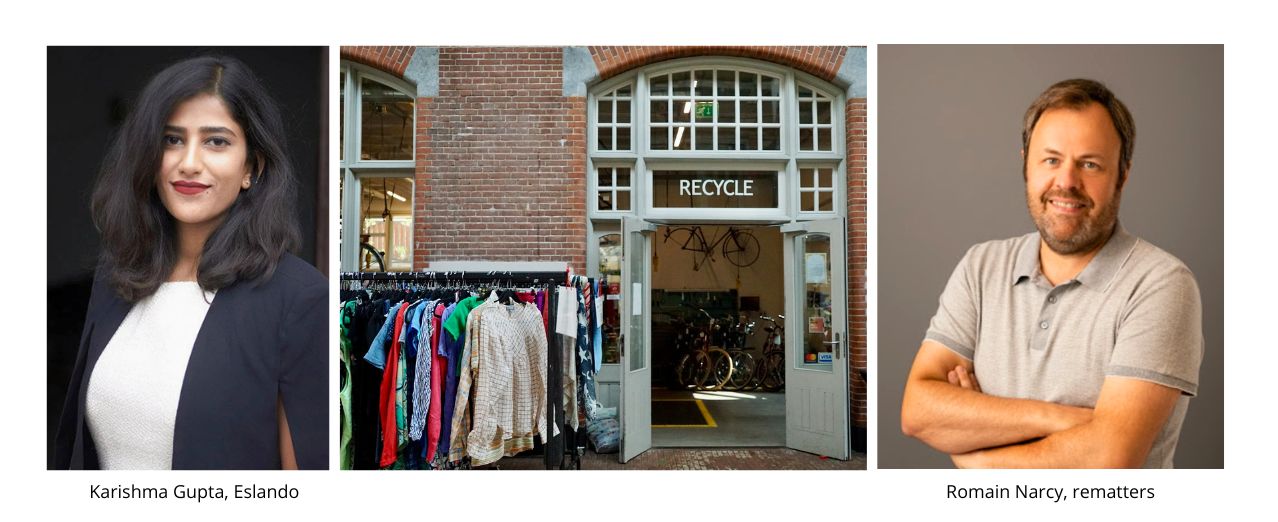
Romain Narcy - rematters - textile recycling solutions Engineering and consultancy solutions focused on the industrial deployment of textile recycling.
Karishma Gupta - Eslando | Textile Recycling Marketplace | Forbes 30 Under 30 Developing digital solutions to connect textile waste suppliers with recycling markets.
Together, they explore the real barriers behind textile-to-textile recycling — from data availability and sorting infrastructure to investment, policy and market demand.
Can textile-to-textile recycling scale without reliable product-level data?
Romain Narcy
No - not at the scale Europe is aiming for.
Moving textile-to-textile recycling from pilot projects to industrial deployment requires much better visibility into incoming materials. Today, significant value is lost because textiles often arrive poorly identified, poorly sorted and not prepared for the right recycling pathway.
Product-level data is not simply a tracking tool - it is an industrial enabler. Reliable information can help direct materials toward reuse, mechanical recycling or chemical recycling routes and create more predictable supply chains.
However, data alone will not solve the challenge. The industry also needs the physical systems capable of acting on this information - from improved collection models to automated pre-sorting and recycling preparation.
Karishma Gupta
Product-level data can significantly support textile recycling, but it is not the only factor determining scalability. Textile-to-textile recycling already works at scale for certain post-industrial waste streams, where material composition is known and consistent.The bigger challenge appears with post-consumer textiles, where mixed materials and limited information make sorting more complex.
Digital Product Passports combined with automated sorting technologies, such as RFID-based identification, could improve efficiency. However, these systems require investment, accurate data input and time before DPP-enabled products reach end-of-life facilities. Reliable data will accelerate progress - but it must be combined with the right infrastructure and market conditions.
What is the biggest barrier to scaling high-quality textile-to-textile recycling in Europe?
Romain Narcy
The biggest challenge is not only technological - it is economic.
Recycled fibres still struggle to compete with lower-cost virgin materials, while investors face uncertainty around the long-term market environment. Scaling textile recycling requires an estimated €8–11 billion in investment, but fragmented policies and unclear market signals continue to slow industrial deployment.
At the same time, growing regulatory demand for recycled content risks moving faster than the availability of high-quality recycled feedstock. Creating a stable market for recycled fibres will be essential to unlock the next phase of growth.
Karishma Gupta
The missing piece is demand certainty.
Europe needs stronger mechanisms, including minimum recycled content targets, to create a reliable market for recycled fibres. Without predictable demand, recyclers cannot secure long-term offtake agreements and investors remain cautious about financing large-scale capacity.
The industry needs a market environment where recycled materials are not only technically possible, but commercially viable.
Where is the most urgent infrastructure gap?
Romain Narcy
The biggest gap is in pre-processing - the missing link between collection, sorting and recycling.
Today, many systems are not designed to efficiently separate reusable textiles from recycling streams or prepare materials at the quality required by industrial recyclers. Critical challenges include removing trims, buttons and zips, separating fibre compositions and creating consistent feedstock streams for mechanical and chemical recycling.
Through the Feedstock Activation Europe project, coordinated by Fashion for Good, rematters is developing a blueprint for future European pre-processing centres, identifying the locations, processes and technologies needed to build this missing layer of infrastructure.
The project is supported by adidas, Bestseller and Inditex.
What are the critical steps to move textile recycling from pilot projects to a functioning industrial market?
Romain Narcy
The next stage requires moving beyond individual pilot projects and building a connected industrial ecosystem. This means deploying the pre-processing infrastructure needed to supply recyclers with reliable feedstock, while creating clearer policy frameworks that reduce investment risks.
Harmonised Extended Producer Responsibility (EPR) systems, clear End-of-Waste criteria and targeted economic support will be essential to create a stable market environment.
Karishma Gupta
The transition will depend on connecting three elements: available waste streams, recycling capacity and market demand. Policy support must create confidence for investors and recyclers, while digital platforms can improve transparency and connect fragmented textile waste streams with the right recycling pathways.
The goal is not only to collect more textiles - it is to ensure they can successfully return into the production cycle.
Conclusion
Digital Product Passports can become an important tool for textile circularity — but they are only one part of a much larger transformation. The industry’s biggest challenge is no longer proving that textile recycling is possible.
The next step is building the systems that can make it economically viable at scale — from collection and sorting to feedstock preparation and demand for recycled fibres. Europe’s textile circular economy will depend not only on knowing what materials enter the system, but on creating the industrial capacity to transform them into new products.
About the experts
rematters
rematters is an engineering and consultancy company focused on the industrial deployment of textile circularity. As technical lead for the Feedstock Activation Europe project coordinated by Fashion for Good, rematters is developing operational standards and infrastructure blueprints for the next generation of European textile pre-processing centres.
Eslando
Eslando is a global textile recycling marketplace connecting waste suppliers with recyclers to enable scalable circular supply chains.
Built for collectors, traders, brands and recyclers, Eslando simplifies the sourcing and sale of textile waste across cotton, polyester, nylon, wool and blended materials - transforming fragmented waste streams into valuable recycling feedstock.
Image credit: unsplash, open sources